Posts

WIth or without a Protocol, Embrace the Wisdom of Others

Imagine for a moment that each day, before working with others, you had an opportunity to explore social media profiles for those people you were to work with. For the sake of this exercise, focus on the profiles you have seen where people are using social media as it was intended, to further personal and professional relationships. Often, these profiles feature “Favorite Quote” sections where individuals can share quotes that are personally profound. The first quote you come across is this one, by football legend Vince Lombardi: “Fatigue makes cowards of us all.” Do you think you could personally and professionally connect with a person whose profile features this quote? The next person’s profile features this quote from the Talmud, a central text of Judaism: “It is not up to you to finish the work, but neither are you free not to take it up.” Can you connect with this person? You then look at a third person’s profile, and she has a quote by former First Lady Eleanor Roos...
Sleep Easy: Dig into those "Feedback Nightmares"

The "Feedback Nightmares Activity" is one of the approximately 30 agenda items that compose a five-day Critical Friends Group Training, and almost undoubtedly, it is an agenda item that always earns a similarly nervous response from trainees when they see it on paper.  Nobody likes a nightmare, and unfortunately many of us have had nightmares that directly involve feedback. Frankly, we would rather not sift through that amidst an otherwise uplifting and pleasant training! However, this activity is meant to help us cast aside those nightmares, setting us up for a bright, new future where feedback can be received gracefully, so our practice can improve without having to experience embarrassment or pain. To run this activity, I always share with my group a story of a real-life feedback experience that changed my career. I share how I spent hours preparing for a planned observation from one of my first administrators and created a lesson that I thought was both fun for student...

"Transition" from People who Work Together to Family

Image
When I got my start in school administration, I was an assistant principal in a Catholic high school where our principal had a great idea. Each day at approximately a half hour before the first bell would ring, she would get on the intercom and invite any faculty and staff in the building to pray, if they desired...and most of them did. We would gather in a circle outside our library and the principal would invite people, voluntarily, to share what they wished to pray for. Some days, no one participated in this part; on these days, the principal would just launch into a prayer with which we were familiar. However, on most days, we would have gobs of participation. People would share good news about children and grandchildren, they would pray for students who needed extra help, and they would share challenging stories that had caused them stress heading into the day. As you can imagine, it was easy to grow close to these people. When people open up and let you know what is really goin...

Student Work Inquiry Rounds can Reveal an Array of Wisdom

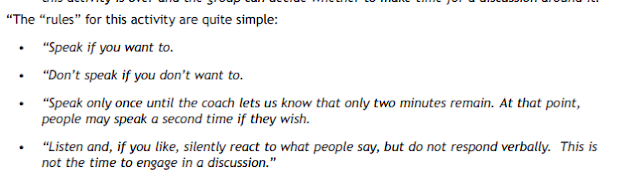
The National School Reform Faculty's "Student Inquiry Rounds" may be just one protocol, but it has many different looks, depending on the way it is being used by a teacher. This protocol invites the "presenter" to bring copies of a piece of student work to a collaborative team. With this protocol, the presenter is asked to say nothing about the work, but simply to distribute it for examination by the group. Individuals in the group then share what can be "seen" by looking at the work, what questions they have, and what interpretations they can make. Only after time is devoted to each of these pieces does the presenter return to answer some of these questions and to reveal his or her purpose in bringing the work to the group. To finish the protocol, the group then discusses potential "next steps" the teacher may take. It may seem frustrating that the true purpose of looking at the student work may not be revealed until the group is deep i...

"Diversity Rounds" Reveals Tapestry of Similarities & Differences

Image
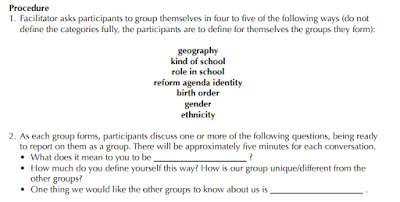
Unfortunately, participants in a regular five-day Critical Friends Group training don't get to experience every protocol in the National School Reform Faculty (NSRF) collection. That collection includes 322 protocols, activities, or modifications that all can be used differently to help your team achieve its goals. One of these protocols is called "Diversity Rounds," and until I had a special request from a group to use it this summer, I had never tried it before. Now that I've tried it, I try to work it into every training! Diversity Rounds requires the facilitator to identify a category where diversity exists. It then allows participants to decide how to best "subdivide" that category into two to four subcategories. The first two steps of the procedure are printed as follows: With the group I was working with, we first used "Birth Order" as a category and after a small hesitation, someone in the room took charge. She suggested the group b...

Time is a Protocol's Ally

Image
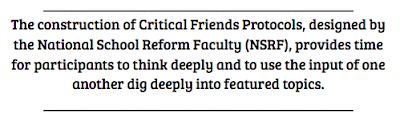
When working with new groups on the use of collaborative protocols, I almost always ask them to complete the following prompt at some point in the training: I used to think ___________, but now I think ___________. This easy sentence stem can produce a wide variety of encouraging responses, allowing me to see the growth the group has experienced in the first part of our training. But while there is always variety, there is one response that is most common in groups that are composed of many people who are new to protocols. They say something similar to this response, which I received at a recent training: I used to think protocols were time consuming and ineffective , but now I think protocols are an efficient way to honor voices and a critical component of true collaboration . The truth is...protocols do take time! However, expertly designed protocols focus the group on key pieces of conversation and eliminate the kind of conversation that takes away from the work. The constr...

Protocols can be Powerful in Pairs

Using NSRF Critical Friends Protocols has made an incredible difference in the schools where I have worked. Whether we have been working through challenging decisions, designing new lessons, or sharing visions for our organization's future, I have been surprised again and again at the implications the protocols have had for our culture and for the students involved. A protocol used during a team meeting can produce some amazing effective and efficient results. However, pulling the whole team together can sometimes be a challenge. This is why I recently began using protocols in meetings much smaller: meetings with one other person. I have discovered that protocols can be powerful in pairs, as well. Two protocols that I have found especially helpful are the "Data-Analysis" Protocol and the "Student Work Inquiry Rounds" Protocol. Both of these protocols encourage the person sharing the data or the student work to turn away from the group so that its individuals ...